
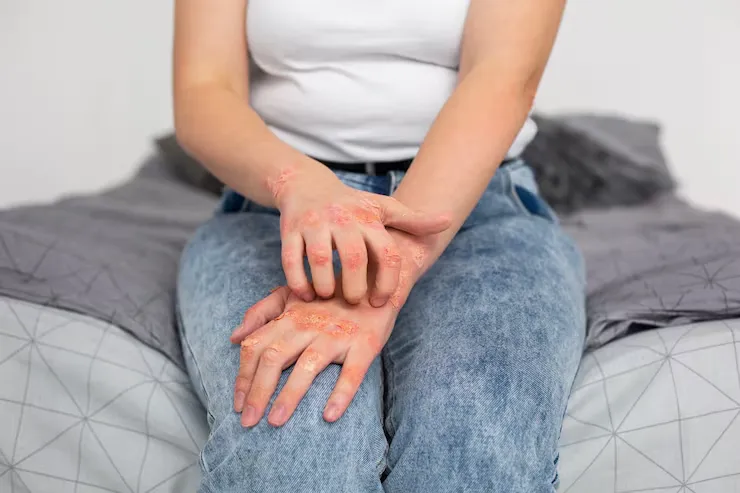

Psoriasis symptoms can begin as small, dry or discoloured patches that are easy to mistake for dandruff, eczema, a fungal infection or simple skin dryness. Over time, the patches may become thicker, scaly, itchy or painful. Some people also develop changes in their nails or stiffness in their joints.
Psoriasis is a long-term, immune-mediated inflammatory condition. It is not contagious, and it does not develop because of poor hygiene. Symptoms often follow a cycle, with periods of improvement followed by flare-ups.
Recognising the early signs can help you obtain the correct diagnosis and begin appropriate care before the symptoms start affecting sleep, movement, confidence or daily life.
What Is Psoriasis?
Psoriasis develops when immune activity causes skin cells to multiply faster than usual. Instead of shedding normally, these cells accumulate on the skin and form raised, inflamed or scaly patches.
The appearance and severity can vary considerably. One person may have a few small patches on the elbows, while another may experience widespread symptoms affecting the scalp, nails, hands, feet or joints.
Psoriasis is not an infection, so it cannot spread to another person through touching, sharing clothes, swimming or physical contact.
You can learn more about its causes and available treatment options on our psoriasis treatment.
What Are the Early Symptoms of Psoriasis?
Early psoriasis symptoms may be mild and may not immediately look like the thick plaques commonly associated with the condition.
Possible early signs include:
- Small, raised patches of dry or inflamed skin
- White, silver, grey or waxy scaling
- Persistent itching, burning or soreness
- Skin that repeatedly cracks or bleeds
- Flaking on the scalp or behind the ears
- Patches that return in the same locations
- Tiny dents or colour changes in the nails
- Stiffness or swelling in a finger or toe
- Symptoms that worsen following stress, illness or skin injury
The patches are often found on both sides of the body, such as both elbows or both knees. However, this pattern is not present in everyone.
What Does Psoriasis Look Like on Different Skin Tones?
Psoriasis does not always appear bright red.
On lighter skin, plaques may look pink or red with silvery-white scales. On brown or black skin, they may appear dark brown, purple, violet or grey. After a patch improves, an area of lighter or darker pigmentation may remain for some time.
Because colour can vary, symptoms such as thickness, scaling, itching, cracking and recurrence are also important when assessing a possible skin condition.
Psoriasis Symptoms by Body Area
Psoriasis can affect almost any part of the body. Its appearance may change depending on where it develops.
Scalp Psoriasis Symptoms
Scalp psoriasis can cause:
- Dry or thick scales on the scalp
- Silvery, white or grey flakes
- Itching, burning or tightness
- Cracking or bleeding after scratching
- Patches extending beyond the hairline
- Scaling behind the ears or on the back of the neck
Severe scalp psoriasis can temporarily increase hair shedding due to inflammation, scratching or forceful removal of scales. Psoriasis itself does not usually destroy the hair follicles.
Unlike ordinary dandruff, scalp psoriasis often creates thicker, more clearly defined patches. However, dandruff, seborrhoeic dermatitis and psoriasis can overlap, so an examination may be necessary.
Psoriasis on the Elbows, Knees and Lower Back
Plaque psoriasis frequently affects the elbows, knees and lower back. The patches may be:
- Raised and clearly defined
- Covered with dry scales
- Itchy or sore
- Prone to cracking during dry weather
- Repeatedly present in the same location
Scratching or picking at the scale can cause bleeding and may make the area thicker.
Psoriasis on the Hands and Feet
Psoriasis on the palms or soles may cause:
- Thick, dry skin
- Deep and painful cracks
- Scaling on the fingers or feet
- Difficulty walking or using the hands
- Small pus-filled bumps in some forms of psoriasis
Hand and foot psoriasis may resemble eczema, contact dermatitis or a fungal infection. It should be diagnosed before treatment is started.
Nail Psoriasis Symptoms
Psoriasis can affect fingernails and toenails, sometimes even when skin symptoms are limited.
Common signs include:
- Tiny dents or pits in the nail
- Yellow, white or brown discolouration
- Rough or crumbling nails
- Thickening beneath the nail
- Separation of the nail from the nail bed
- Tenderness around the nail
Nail changes can also occur with fungal infections. A doctor may recommend testing if the diagnosis is uncertain.
Psoriasis in Skin Folds
Psoriasis occurring under the breasts, in the armpits, around the groin or between the buttocks is known as inverse psoriasis.
Instead of dry scales, it may produce smooth, shiny and inflamed patches. Moisture, heat and friction can make these areas sore or painful.
What Are the Main Types of Psoriasis?
The type of psoriasis influences its appearance, location and urgency.
1. Plaque Psoriasis
Plaque psoriasis is the most common form. It causes raised, thickened patches covered with dry scales. These plaques often develop on the scalp, elbows, knees and lower back.
The patches may itch, burn, crack or bleed.
2. Guttate Psoriasis
Guttate psoriasis causes many small, drop-shaped, scaly spots. It often appears suddenly across the chest, back, arms or legs.
This type is more common in children and young adults and can occur following an infection, particularly a streptococcal throat infection. A medical assessment can help determine whether an infection needs treatment.
3. Inverse Psoriasis
Inverse psoriasis develops in skin folds. Its patches are usually smooth and sore, with little visible scaling.
It may be mistaken for a fungal infection because both conditions can affect warm and moist areas.
4. Pustular Psoriasis
Pustular psoriasis produces pus-filled bumps surrounded by inflamed or tender skin. The pus is not necessarily caused by a bacterial infection.
When limited to the palms and soles, it can make walking or using the hands painful. When pustules spread rapidly across the body or occur with fever and weakness, urgent medical care is required.
5. Erythrodermic Psoriasis
Erythrodermic psoriasis is a rare but serious form in which large areas of the body become inflamed, painful and may peel.
It can interfere with the body’s ability to control temperature and fluid balance. Widespread redness or discolouration, peeling, fever, chills, weakness or a rapid heartbeat requires immediate emergency assessment.
Psoriasis Versus Other Skin Conditions
Several conditions can look similar to psoriasis. Avoid self-diagnosing from photographs alone.
| Condition | Common Features |
|---|---|
| Psoriasis | Thick, defined and recurring patches with white, silver or grey scale |
| Eczema | Often very itchy, dry and inflamed, sometimes with oozing or crusting |
| Fungal infection | May form a circular or expanding rash with a clearer centre |
| Dandruff | Usually causes loose scalp flakes without thick, defined plaques |
| Contact dermatitis | Appears after exposure to an irritant or allergen and may burn or itch |
A person can have more than one skin condition at the same time. Using an antifungal, steroid or combination cream without a diagnosis may temporarily alter the rash and make later assessment more difficult.
Can Psoriasis Affect More Than the Skin?
Psoriasis can also affect the nails, joints and emotional well-being.
Some people with psoriasis develop psoriatic arthritis. Early symptoms may include:
- Morning joint stiffness
- Painful or swollen fingers and toes
- A finger or toe becoming swollen along its full length
- Heel pain
- Lower back or neck stiffness
- Tenderness where tendons attach to bones
- Nail pitting together with joint discomfort
Joint symptoms should not be ignored. Untreated inflammatory arthritis can lead to permanent joint damage. A dermatologist or rheumatologist may be needed for further assessment.
Visible or uncomfortable patches may also affect sleep, social confidence, work and mental health. Discuss these effects with your doctor because they are an important part of psoriasis care.
What Causes Psoriasis Symptoms to Flare?
The exact cause of psoriasis is not fully understood. It involves immune activity and genetic susceptibility. Certain factors can then trigger a first episode or worsen existing symptoms.
Common psoriasis triggers include:
- Emotional or physical stress
- Cuts, scratches, burns or other skin injuries
- Throat and other infections
- Cold or dry weather
- Sunburn
- Smoking
- Frequent or excessive alcohol consumption
- Poor sleep
- Certain prescription medicines
- Stopping some psoriasis medicines suddenly
- Friction from tight clothing
- Individual lifestyle or dietary triggers
Triggers differ between patients. A symptom diary can help you record your food, stress, sleep, weather, infections, medicines and skin changes.
For practical guidance, read our article about foods, stress and lifestyle triggers associated with psoriasis.
Do not stop a prescribed medicine because you suspect it is triggering psoriasis. Speak with the prescribing doctor first.
How Is Psoriasis Diagnosed?
There is no single routine blood test that confirms ordinary plaque psoriasis.
A doctor or dermatologist will usually:
- Examine the skin, scalp and nails.
- Ask when the patches appeared and whether they recur.
- Review itching, pain, bleeding and joint symptoms.
- Ask about family history, infections, stress and medicines.
- Check how much of the body is affected.
- Consider whether another condition could explain the symptoms.
A small skin sample or biopsy is occasionally needed when the appearance is unclear. Additional tests may be recommended if fungal infection, inflammatory arthritis or another medical problem is suspected.
When Should You See a Doctor?
Arrange a medical consultation if:
- A new rash does not improve
- Patches are spreading or becoming thicker
- Itching regularly disturbs sleep
- The skin is painful, cracked or bleeding
- The scalp has persistent thick scaling
- Nails become pitted, discoloured or detached
- Symptoms affect the face, genitals, hands or feet
- You have recurring joint stiffness, pain or swelling
- Treatment is not working or is causing unwanted effects
- The condition is affecting confidence, work or mental health
Early assessment is especially important when joint symptoms are present.
When Is Psoriasis an Emergency?
Seek urgent medical care if you develop:
- Rapidly spreading pustules
- Widespread inflamed or peeling skin
- Fever, chills or severe weakness
- A fast heartbeat or dizziness
- Severe pain or dehydration
- Signs of infection, such as increasing warmth, swelling or discharge
- Eye pain, redness or changes in vision
- A severe reaction after starting or stopping medication
These symptoms should not be managed only with home remedies or complementary treatment.
How Are Psoriasis Symptoms Treated?
Treatment depends on the psoriasis type, severity, location, effect on daily life and whether the nails or joints are involved.
A dermatologist may recommend:
- Moisturisers or emollients
- Prescription topical treatment
- Medicated scalp products
- Phototherapy
- Oral medicines
- Injectable or biologic treatment
- Treatment for psoriatic arthritis
Do not stop prescribed treatment suddenly. Some treatments require gradual adjustment and medical monitoring.
Safe everyday measures may include using lukewarm water, applying an unperfumed moisturiser, avoiding harsh soaps, resisting the urge to pick scales and protecting the skin from injury.
How Dr. Tathed’s Homeopathic Clinic Can Support You
At Dr. Tathed’s Homeopathic Clinic, a psoriasis consultation considers the location and appearance of the patches, flare pattern, itching, sleep, stress, family history, previous treatment, nail changes and joint symptoms.
For patients exploring homeopathic medicine for psoriasis, homeopathy should be viewed as complementary support and not as a replacement for dermatological diagnosis or medically necessary treatment. Evidence for homeopathy in treating psoriasis remains limited, and no responsible practitioner should promise a permanent cure.
If symptoms are severe, rapidly spreading or associated with joint inflammation, infection or emergency warning signs, appropriate dermatology, rheumatology or urgent medical assessment should be prioritised.
Get Personalised Psoriasis Care
Recurring itching, scaling or skin patches deserve a correct diagnosis. Dr. Tathed’s Homeopathic Clinic provides personalised consultations at:
- Psoriasis Treatment in Chinchwad (PCMC, Pune): Opposite Lokmanya Hospital, Near Railway Bridge, Renuka Sai Society, Ganesh Nagar, Chinchwad, Pimpri-Chinchwad, Maharashtra 411033
- Psoriasis Treatment in Viman Nagar (Pune): Datta Mandir Chowk, Unit 106, 1st Floor, Lunkad Skymax Mall, Konark Nagar, Clover Park, Viman Nagar, Pune, Maharashtra 411014
- Psoriasis Treatment in Naupada, Thane West: Office No. 207, JVM’s Corner Stone, Hariniwas Circle, Lal Bahadur Shastri Marg, Naupada, Thane West, Thane, Maharashtra 400602
Online Homeopathic Consultation Available – Consult with our homeopathy doctors from anywhere through online appointments.
For an assessment of recurring skin symptoms, you can book a consultation with Dr. Tathed’s Homeopathic Clinic.
Conclusion
Psoriasis symptoms are not limited to visible skin patches. The condition may affect the scalp, nails, hands, feet, joints, sleep and emotional well-being. Because psoriasis can resemble eczema, fungal infection and dandruff, obtaining a proper diagnosis is safer than repeatedly experimenting with over-the-counter products.
Seek medical care if symptoms persist, spread, affect your nails or joints, or interfere with daily life. Rapidly spreading pustules, widespread peeling, fever or severe weakness require urgent medical attention.
Frequently Asked Questions
What do the early symptoms of psoriasis look like?
Early psoriasis may appear as small, dry, raised or discoloured patches with mild scaling. The area may itch, burn or repeatedly return in the same location. Scalp flaking and nail pitting can also be early signs.
Is psoriasis contagious?
No. Psoriasis is an immune-mediated inflammatory condition. It cannot spread through touching, sharing clothes, physical contact or swimming.
Can psoriasis be cured permanently?
Psoriasis is generally a long-term condition with periods of flare and remission. There is currently no guaranteed permanent cure, but suitable treatment can control symptoms and improve quality of life.
How can I tell the difference between dandruff and scalp psoriasis?
Dandruff usually produces loose flakes. Scalp psoriasis tends to cause thicker, defined patches that may extend beyond the hairline or appear behind the ears. A medical examination is recommended when flaking is persistent or severe.
Does joint pain with psoriasis require medical attention?
Yes. Recurring joint pain, swelling or morning stiffness may indicate psoriatic arthritis. Early assessment is important because uncontrolled inflammation can cause permanent joint damage.
Can psoriasis appear only on the nails?
Yes. Nail psoriasis can sometimes occur with very limited skin symptoms. Nail pitting, discolouration, crumbling or separation should be assessed because fungal infections can cause similar changes.
Can homeopathy cure psoriasis?
There is insufficient reliable evidence to claim that homeopathy cures psoriasis. It may be discussed as complementary support with a qualified practitioner, but it should not replace diagnosis, prescribed treatment or dermatologist-led care.
How does Dr. Tathed’s Homeopathic Clinic assess psoriasis symptoms?
Dr. Tathed’s Homeopathic Clinic reviews the appearance and distribution of patches, itching, flare triggers, stress, sleep, medical history, previous treatments, nail changes and joint symptoms. Patients can consult at Chinchwad in PCMC-Pune, Viman Nagar or Thane West. Dermatology or urgent medical referral is recommended whenever the symptoms require it.
Medical note: This article provides general educational information. It does not diagnose psoriasis or replace advice from a dermatologist or another qualified healthcare professional. Do not start, stop or replace prescribed treatment without medical guidance.
References :
- Psoriasis symptoms, causes and risk factors from NIAMS
- Psoriasis signs, symptoms and types from the American Academy of Dermatology
- Psoriasis diagnosis and treatment guidance from NIAMS
- Psoriasis symptoms and treatment information from the NHS
- Psoriasis diagnosis and treatment from the American Academy of Dermatology