
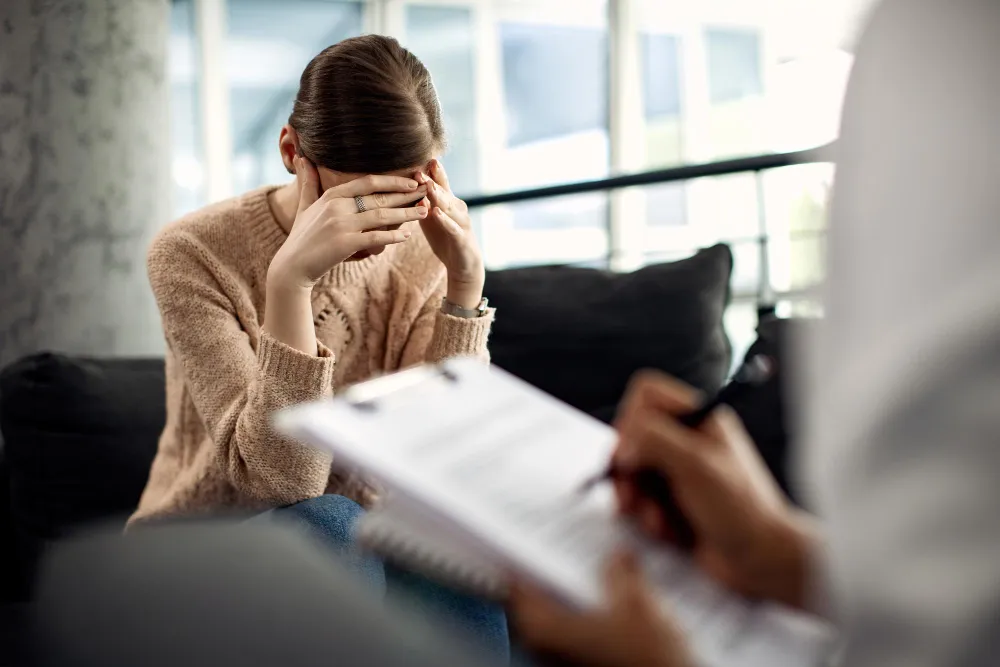

You are not imagining it.
The tightness in your chest that shows up before a meeting nobody else seems bothered by. The sleep that vanishes at 2 AM and does not return, while your mind replays every uncomfortable conversation from the past week. The irritability that you cannot quite explain to your family, the low-grade dread that sits in your stomach through an otherwise ordinary Tuesday.
You have probably told yourself it is just stress. That everyone feels this way. That you just need a holiday, or a better sleep schedule, or to stop overthinking things.
But it does not go away. It just changes shape.
Anxiety disorders are the most common mental health condition in the world, and they remain one of the most underdiagnosed and undertreated, particularly in India, where the cultural weight of being seen as unable to cope keeps millions of people from ever seeking help. By the time most patients walk into a clinic, they have been managing this for years on their own.
Conventional medicine offers a standard response: antidepressants, benzodiazepines, or a referral to a therapist. For many people, these work well. For many others, the medication brings its own complications, dependence, withdrawal, blunted emotion, weight changes, or simply a feeling that the anxiety is suppressed rather than resolved.
Homeopathy approaches anxiety from a completely different direction. It does not suppress symptoms. It looks at why this particular person, with this particular history, in this particular life situation, developed anxiety in the first place. And it treats that.
If you are looking for homeopathy treatment for anxiety in Thane, this guide explains how it works, what the evidence shows, and what you can realistically expect from a properly managed homeopathic approach.
What Anxiety Actually Is and What It Is Not
Anxiety is not weakness. It is not a character flaw. It is not something you can simply will away with positive thinking or a morning jog, though both can help at the margins.
Anxiety is the nervous system stuck in a threat-detection loop. The amygdala, the part of the brain that reads danger signals, fires a stress response faster than the thinking brain can intervene. Heart rate rises. Muscles tighten. Digestion slows. The mind narrows its focus to the perceived threat and cannot easily redirect. In a genuine emergency, this response saves lives. In a traffic jam, or a work presentation, or a family argument, it creates suffering without any useful function.
Anxiety disorders come in several forms. Generalized Anxiety Disorder (GAD) produces persistent, hard-to-control worry across multiple areas of life. Panic disorder involves sudden surges of intense fear that feel like a cardiac event. Social anxiety creates overwhelming self-consciousness in interpersonal situations. Health anxiety, also called hypochondria, locks the mind onto physical sensations and catastrophizes them. Obsessive-Compulsive Disorder involves intrusive thoughts and compulsive rituals. Each of these presents differently, responds to different triggers, and, in homeopathy, requires a completely different prescription.
That last point is critical.
A homeopath does not treat anxiety as a single condition with a standard remedy. They treat the individual who has anxiety, and that individual is unlike every other patient in the waiting room.
How Widespread Is Anxiety in India?
- India carries approximately 44.9 million cases of anxiety disorders, making it one of the highest-burden countries for mental health conditions globally. (WHO World Mental Health Report, 2022)
- A 2016 National Mental Health Survey found that nearly 1 in 5 Indians experience a significant mental health condition at some point in their lives, with anxiety and depression accounting for the largest share. Only 10 to 12% of those who need care actually receive it.
- In urban Maharashtra, including cities like Thane and Pune, anxiety and stress-related disorders are among the top five presenting complaints in outpatient mental health facilities. Work pressure, financial stress, and family conflict are consistently cited as primary triggers. (NIMHANS National Mental Health Survey, 2016)
- A 2025 pan-India survey by LocalCircles found that only 24% of homeopathy users reported side effects over a decade, compared to 51% for allopathic medications. For long-term anxiety management, this difference in tolerability significantly influences patient choice.
These numbers reflect something important. Anxiety in India is not rare, and it is not being adequately treated by the existing system. A large number of people are managing it alone, managing it poorly, or managing it with medication they would rather not stay on for the rest of their lives.
How Homeopathy Treats Anxiety
The first thing to understand is that homeopathy does not have an anxiety remedy the way a pharmacy stocks an antianxiety drug. There is no single bottle that addresses all anxiety in all patients. Instead, the prescription emerges from a detailed picture of the individual.
In our clinic in Thane, the first consultation for an anxiety patient takes a significant amount of time. We want to understand far more than the anxiety itself. When did it begin? What happened in life around that time? Is the anxiety worse in crowds or in isolation? Does it drive you toward reassurance-seeking or withdrawal? Does it arrive as physical symptoms first, a tight chest, a racing heart, a rolling stomach, or as mental spiraling? What does your sleep look like? Your appetite? Your digestion? Are you sensitive to criticism? Do you fear specific things, like illness, death, failure, abandonment, embarrassment?
These are not random questions. Every answer builds the constitutional picture.
The remedy chosen matches that total picture. Two patients with generalized anxiety disorder will almost certainly receive different remedies if one is a people-pleaser who cannot say no and dreads disapproval, while the other is a high-achiever with health anxiety who reads medical journals at midnight. Their anxiety looks similar from the outside. Its roots, its patterns, and its constitutional soil are completely different.
Homeopathy addresses anxiety on multiple levels simultaneously:
- The mental and emotional experience: the specific fears, thought patterns, and emotional triggers that drive the anxiety
- The physical symptoms: palpitations, shortness of breath, muscle tension, digestive disturbance, sweating, and sleep disruption
- The constitutional susceptibility: why this person's nervous system responds the way it does, and how to reduce that reactivity at the root
- Co-occurring conditions: many anxiety patients also carry chronic insomnia, IBS, skin conditions, or hormonal imbalances that homeopathy addresses in the same prescription
The effect is not sedation. Patients on well-chosen homeopathic remedies do not describe feeling blunted or artificially calm. They describe feeling more like themselves. More able to think clearly. Less reactive. Better slept. The anxiety does not disappear instantly, but its grip loosens, and it loosens in a way that builds over time rather than requiring a higher dose to maintain.
Types of Anxiety Homeopathy Treats Effectively
Homeopathy works across the full range of anxiety presentations. The conditions below respond well to constitutional homeopathic treatment when properly prescribed.
Generalized Anxiety Disorder (GAD):
Persistent worry about work, health, finances, family, and the future that the patient cannot switch off. Homeopathy reduces the intensity of the worry cycle and improves the patient's ability to tolerate uncertainty without catastrophizing.
Panic Disorder:
Sudden, intense surges of fear with physical symptoms that mimic cardiac events. Homeopathic treatment addresses the constitutional sensitivity that produces panic attacks and reduces both their frequency and severity over time.
Social Anxiety:
Fear of judgment, embarrassment, and negative evaluation in social situations. Social anxiety is one of the conditions where homeopathy shows particularly good results because the remedy targets the exact nature of the self-consciousness, not just its surface expression.
Health Anxiety:
Persistent fear of serious illness despite medical reassurance. This is a pattern of anxious thinking more than a medical condition, and homeopathy addresses the underlying fear of death or disease that drives it at the constitutional level.
Anxiety with Depression:
Many patients carry both simultaneously. Homeopathy treats the whole person and does not require separate prescriptions for anxiety and depression. The constitutional remedy addresses the emotional landscape as a whole.
Anxiety in Children and Adolescents:
School anxiety, separation anxiety, exam fear, and social withdrawal in young people respond well to homeopathic treatment. At our Thane clinic, we work with children from a young age, and the absence of sedative side effects makes homeopathy particularly suitable for this group.
What to Realistically Expect from Homeopathic Treatment
This is the question every new patient asks. The honest answer is this.
The first changes most anxiety patients notice are in sleep and physical symptoms, usually within the first two to four weeks. The racing heart before sleep quiets. The 3 AM waking becomes less frequent. The stomach settles. These early physical shifts are the nervous system beginning to recalibrate.
Mental and emotional changes follow over weeks to months. The automatic catastrophizing starts to slow. The gap between a trigger and a reaction widens. Patients describe starting to catch themselves before the spiral fully begins. That metacognitive shift, noticing the anxiety rather than being inside it, is one of the most reliable markers of genuine progress.
For chronic anxiety that has been present for years, expect a treatment period of several months. Homeopathy works at a depth that requires time. The longer a condition has existed, the longer the resolution takes. But the improvements that come from properly managed homeopathic treatment tend to be durable, because the prescription has addressed the underlying susceptibility, not just the presenting symptom.
Follow-up consultations matter. As the patient changes, the prescription may need refinement. This is not failure. This is the treatment working and the next layer emerging. Most anxiety patients stabilize within six to twelve months of consistent treatment and move to less frequent follow-ups as their condition improves.
Homeopathy Treatment for Anxiety in Thane: Book a Consultation
Do not wait for the anxiety to become unmanageable. The earlier a proper evaluation takes place, the faster the constitutional picture becomes clear and the more precise the treatment.
At Dr. Tathed's Homeopathic Clinic, we have treated hundreds of anxiety patients across Thane, Pune, Viman Nagar, and Chinchwad, from mild situational anxiety to long-standing generalized anxiety disorder with physical complications. Every case receives a full constitutional intake, a carefully chosen remedy, and close follow-up as the treatment progresses.
To book a consultation, visit drtathed.com or call +91 9405 435 981. Working hours are 8:00 AM to 9:00 PM. Early care makes all the difference.
Frequently Asked Questions (FAQs)
How long does homeopathic treatment for anxiety take?
It depends on how long the anxiety has been present and its severity. Mild anxiety of recent onset often shows meaningful improvement within six to eight weeks. Long-standing generalized anxiety disorder or panic disorder typically requires four to six months of consistent treatment before the improvements become stable. The goal is not just symptom relief but a genuine reduction in the underlying susceptibility, which takes more time but produces more durable results.
Can homeopathy completely cure anxiety?
For many patients, yes. For some, the goal shifts toward long-term management rather than complete resolution, particularly where the anxiety has a strong constitutional basis or where significant life stressors are ongoing. A qualified homeopath will give you an honest assessment of what is realistic for your specific case after the first consultation, not a blanket promise.
Is it safe to use homeopathy alongside antidepressants or anti-anxiety medication?
In most cases, yes. Homeopathic remedies do not interact chemically with pharmaceutical medications because they are not pharmacologically active in the conventional sense. Many patients begin homeopathic treatment while still on conventional medication and gradually reduce their pharmaceutical dose under the guidance of their prescribing physician as their condition improves. Never reduce or stop prescribed medication without informing your doctor, regardless of how well you feel.
What makes homeopathy different from therapy for anxiety?
Therapy, particularly Cognitive Behavioural Therapy, works with conscious thought patterns and behavioural responses to anxiety. It is effective and well-evidenced. Homeopathy works at a different level: the constitutional susceptibility of the nervous system itself. The two approaches are not in competition. Many of our patients combine homeopathic treatment with therapy and find that each supports the other. Homeopathy reduces the physiological intensity of the anxiety, which makes the cognitive work of therapy easier to do.
Do homeopathic remedies cause drowsiness or affect concentration?
No. This is one of the most important distinctions between homeopathic treatment and conventional anxiolytics. Benzodiazepines and some antidepressants cause sedation, cognitive dulling, and coordination issues. Homeopathic remedies produce none of these effects. Patients report feeling calmer, but not sedated. They describe clarity of thought improving rather than diminishing. This makes homeopathy particularly suitable for students, professionals, and anyone whose livelihood depends on mental sharpness.
References
- WHO World Mental Health Report (2022)
- NIMHANS National Mental Health Survey of India (2015-16)
- LocalCircles Pan-India Survey on Medical Side Effects (April 2025)
- NCCIH on Homeopathy
- Ministry of AYUSH, Government of India
- Journal of Preventive Medicine and Holistic Health: Integrative Medicine for Chronic Conditions (2024)