
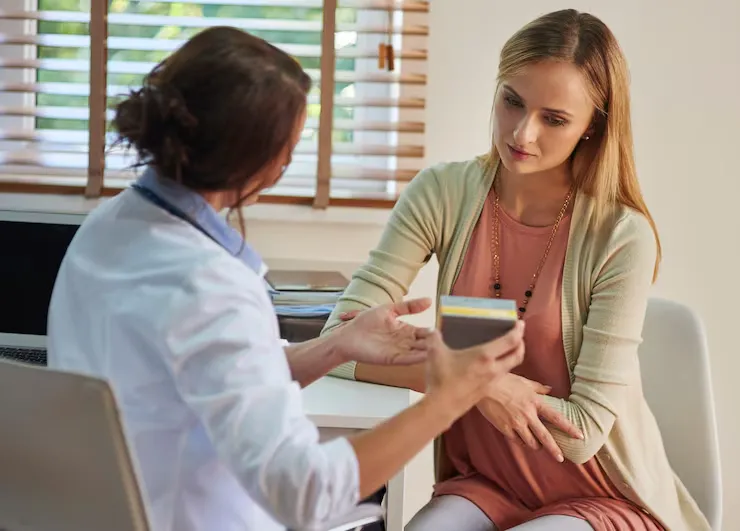

Many women first suspect PCOD or PCOS when periods become irregular, acne increases, facial hair appears, weight becomes difficult to control, or pregnancy does not happen as expected. At this stage, the most common question is, “How do I know if I have PCOD or PCOS?” The answer is simple but important: symptoms can create suspicion, but proper PCOD and PCOS tests are needed to understand the condition correctly.
Online checklists, social media posts and ultrasound terms can create confusion. Some women see “bilateral PCOD” on a scan report and immediately panic. Others have irregular periods but a normal ultrasound and think everything is fine. Both reactions can be misleading.
PCOS is diagnosed by looking at a combination of symptoms, hormone-related signs, ovulation pattern and sometimes ultrasound findings. PCOD is commonly used in India to describe polycystic ovarian changes or ovary-related hormonal concerns, but the term may be used differently by different doctors.
This blog explains what tests may be advised, what an ultrasound scan means, what bilateral PCOD means, and when women should consult a doctor.
Can PCOD or PCOS Be Diagnosed by Symptoms Alone?
No. Symptoms are important, but they are not enough for a confirmed diagnosis. Irregular periods, acne, hair fall, weight gain and facial hair can happen for different reasons. Thyroid disorders, high prolactin levels, stress, weight changes, medication effects and other hormonal conditions can also disturb periods.
That is why a proper medical evaluation is needed. A doctor will usually ask about your cycle history, age, symptoms, family history, weight changes, skin changes and fertility goals. After this, tests may be suggested.
Symptoms help doctors decide what to check. Tests help confirm what is happening inside the body.
Common Symptoms That May Need PCOD or PCOS Testing
You may need evaluation if you have:
- Periods that are frequently delayed
- Missed periods
- Very irregular cycles
- Acne that continues after teenage years
- Excess facial hair growth
- Hair thinning on the scalp
- Unexplained weight gain
- Difficulty losing weight
- Dark patches on the neck or underarms
- Oily skin
- Mood changes
- Difficulty conceiving
- Repeated ovarian cyst-like findings on ultrasound
If you are trying to conceive and your periods are irregular, do not wait too long. Ovulation problems are one of the common reasons pregnancy gets delayed in PCOS. You can consult for female infertility treatment if menstrual irregularity and fertility concerns are present together.
PCOD Test Means: What Does It Include?
When people search for “PCOD test means,” they are usually asking which test confirms PCOD. There is no single test that confirms every case. Evaluation usually includes a combination of clinical history, physical signs, ultrasound and blood tests.
The doctor may check:
- Menstrual cycle pattern
- Acne and hair growth pattern
- Weight and waist changes
- Signs of insulin resistance
- Hormonal imbalance
- Ovulation pattern
- Ultrasound appearance of ovaries
The test plan may differ for every woman. A teenager, unmarried woman, married woman trying to conceive and a woman with severe acne may not need the same tests.
PCOD Scan: What Does Ultrasound Show?
A PCOD scan usually refers to a pelvic ultrasound. Ultrasound uses sound waves to create images of the ovaries and uterus. It may show whether the ovaries are enlarged or whether multiple small follicles are present.
Many women think these are “cysts,” but in PCOS they are usually small follicles. These follicles are not the same as dangerous ovarian cysts or tumours. They are related to ovulation changes.
An ultrasound may show:
- Ovarian size
- Number of small follicles
- Uterine lining thickness
- Any other pelvic findings
- Whether one or both ovaries show polycystic appearance
However, ultrasound alone does not always confirm PCOS. Some women with PCOS may not show typical ovarian changes. Some women may have polycystic-looking ovaries but not have the full syndrome.
What Does Bilateral PCOD Mean?
“Bilateral PCOD” means that both ovaries show a polycystic appearance on ultrasound. “Bilateral” means both sides. This can sound frightening, but it does not automatically mean something dangerous.
It means the scan has seen multiple small follicles or polycystic ovarian morphology in both ovaries. The next step is to connect this scan finding with your symptoms and hormone profile.
For example:
- If you have bilateral PCOD on scan but regular periods and no androgen symptoms, the doctor may observe and evaluate based on your case.
- If you have bilateral PCOD, irregular periods, acne, facial hair and weight gain, the doctor may evaluate for PCOS.
- If you are trying to conceive, ovulation assessment may become important.
Do not panic after reading one ultrasound line. Discuss the report with a qualified doctor.
Difference Between Bilateral Polycystic Ovaries and PCOS
This is an important point. Bilateral polycystic ovaries and PCOS are not always the same.
Bilateral polycystic ovaries describe how the ovaries look on ultrasound. PCOS is a syndrome that includes hormonal, menstrual, ovulation and metabolic factors.
A woman may have polycystic-looking ovaries but not have PCOS. Another woman may have PCOS symptoms even if ultrasound findings are not very clear. This is why diagnosis should not depend only on scan images.
A proper diagnosis looks at the whole picture.
PCOS and PCOD Blood Tests
Blood tests may be advised to understand hormone levels and rule out other causes of irregular periods. Your doctor may suggest tests depending on your symptoms.
Commonly considered tests may include:
- Testosterone or androgen-related tests
- LH and FSH
- Thyroid profile
- Prolactin
- Fasting blood sugar
- Insulin-related evaluation
- HbA1c
- Lipid profile
- Vitamin D or B12 if clinically needed
- AMH in selected cases
Not every woman needs every test. Testing should be based on symptoms, age, menstrual pattern and fertility needs.
Why Thyroid and Prolactin Tests May Be Suggested
Many women are surprised when doctors advise thyroid or prolactin tests for irregular periods. This is because thyroid imbalance and high prolactin can also disturb menstrual cycles. If these are not checked, a woman may be wrongly labelled as PCOD or PCOS.
Good diagnosis means ruling out conditions that can look similar. This is especially important when periods are missed for months, bleeding is heavy, or fertility is delayed.
How Doctors Check Ovulation
Ovulation means the ovary releases an egg. In PCOS, ovulation may be delayed or irregular. If a woman is trying to conceive, ovulation tracking becomes important.
Doctors may assess ovulation through:
- Menstrual history
- Follicular study
- Blood tests in selected cases
- Cycle tracking
- Basal body temperature or ovulation kits in some cases
If periods are very irregular, ovulation prediction kits may become difficult to interpret. Medical guidance is better in such cases.
How to Know If You Have PCOS or PCOD
You may suspect PCOD or PCOS if you have irregular periods along with acne, facial hair, weight changes or fertility difficulty. But confirmation needs evaluation.
A practical approach is:
Step 1: Track Your Periods
Write down your cycle dates for at least 3 months. Note delayed periods, missed periods, heavy bleeding or spotting.
Step 2: Observe Skin and Hair Changes
Notice acne, oily skin, scalp hair thinning, facial hair or dark skin patches.
Step 3: Check Weight and Lifestyle Pattern
Sudden weight gain, difficulty losing weight, poor sleep, stress and low activity may worsen symptoms.
Step 4: Consult a Doctor
Do not depend only on online searches. A doctor can decide whether you need blood tests, ultrasound or other evaluation.
Step 5: Follow a Personalised Plan
Treatment depends on whether your main concern is periods, acne, weight, hair growth, fertility or long-term health.
If your symptoms are already affecting periods or fertility, you can read about PCOS treatment and consult for a personalised plan.
Can PCOD or PCOS Be Missed?
Yes, it can be missed, especially when symptoms are mild. Some women have irregular periods for years but do not seek help. Others use temporary medicines to induce periods without understanding the reason. Some women have acne or hair growth and only treat the skin, while the hormonal issue remains unaddressed.
PCOS may also be missed in lean women because many people wrongly believe PCOS happens only in overweight women. A woman can have PCOS with normal body weight.
When Should You Not Delay Testing?
Do not delay testing if:
- You miss periods for more than 2 to 3 months
- Your cycle is frequently longer than 35 to 40 days
- You are trying to conceive
- You have facial hair growth
- Acne is worsening
- Hair fall is severe
- Weight is increasing quickly
- You have dark neck or underarm patches
- Period bleeding is very heavy
- You have pelvic pain or unusual symptoms
Early evaluation can prevent years of confusion and repeated symptom-based treatment.
PCOD and PCOS Testing for Fertility
If pregnancy is delayed, PCOD or PCOS testing may be part of a fertility evaluation. Ovulation problems are common in PCOS, but they are not the only cause of infertility. The male partner’s fertility, fallopian tube health, egg quality, thyroid, prolactin and other factors may also matter.
This is why couples should avoid assuming that PCOD or PCOS is the only reason for delayed pregnancy. A proper fertility evaluation is more useful.
You can consult for infertility homeopathy treatment if you are looking for support for hormonal imbalance, irregular periods and fertility-related concerns.
Homeopathy Support After Diagnosis
Once PCOD or PCOS is properly evaluated, homeopathy may be considered as a personalised treatment approach. A homeopathy doctor may assess menstrual pattern, emotional stress, sleep, appetite, digestion, skin symptoms, hair growth, weight tendency and fertility goals.
The aim is to understand the person’s full health picture and support long-term regulation. Diagnostic tests should not be skipped when they are clinically needed.
Women in Pune, Viman Nagar, Chinchwad, Thane and Mumbai can consult early if symptoms are persistent.
Conclusion: Diagnosis Requires More Than an Ultrasound Report
PCOD and PCOS cannot be confirmed only through symptoms or one ultrasound line. A proper diagnosis needs menstrual history, physical signs, scan findings and blood tests where required. “Bilateral PCOD” on a report should not create panic, but it should be evaluated correctly.
If you have irregular periods, acne, hair growth, weight gain or difficulty conceiving, timely testing can help you understand the condition and start the right care.
Start Your Women's Health Assessment Today
If you need PCOD or PCOS testing guidance in Pune, Viman Nagar, Chinchwad, Thane Mumbai, book a consultation with Dr. Tathed’s Homeopathy Clinic for a personalised menstrual and hormonal health evaluation.
Find Your Nearest Homeopathy Clinic
- Homeopathy Clinic in Chinchwad, Pune : Opposite lokmanya hospital, near railway bridge, Renuka Sai Society, Ganesh Nagar, Chinchwad, Pimpri-Chinchwad, Maharashtra 411033
- Homeopathy Clinic in Viman Nagar, Pune : Datta Mandir Chowk, Unit 106, 1st Floor, Lunkad Skymax Mall, Konark Nagar, Clover Park, Viman Nagar, Pune, Maharashtra 411014
- Homeopathy Clinic in Thane West : Office No. 207, JVM’s Corner Stone, Hariniwas Circle, Lal Bahadur Shastri Marg, Naupada, Thane West, Thane, Maharashtra 400602
FAQs
1. What is the test for PCOD and PCOS?
There is no single test. Doctors may use menstrual history, physical examination, ultrasound and blood tests to evaluate PCOD or PCOS.
2. What does PCOD scan mean?
A PCOD scan usually means ultrasound of the ovaries. It checks ovarian size, multiple follicles and other pelvic findings.
3. Is bilateral PCOD dangerous?
Bilateral PCOD means both ovaries show polycystic appearance on ultrasound. It is not automatically dangerous, but it should be discussed with a doctor along with symptoms and blood tests.
4. Can I have PCOS with a normal ultrasound?
Yes, it is possible. PCOS diagnosis depends on more than ultrasound. Symptoms, ovulation pattern and androgen levels also matter.
5. Which blood tests are done for PCOS?
Doctors may advise androgen tests, LH, FSH, thyroid, prolactin, blood sugar, HbA1c, insulin-related tests and lipid profile depending on symptoms.
6. Should I test for PCOS if I have irregular periods?
Yes, if irregular periods are repeated or associated with acne, hair growth, weight gain or fertility difficulty, you should consult a doctor.
Reference Links
https://www.nichd.nih.gov/health/topics/pcos/conditioninfo/diagnose
https://www.acog.org/womens-health/faqs/polycystic-ovary-syndrome-pcoshttps://www.aafp.org/pubs/afp/issues/2016/0715/p106.html