
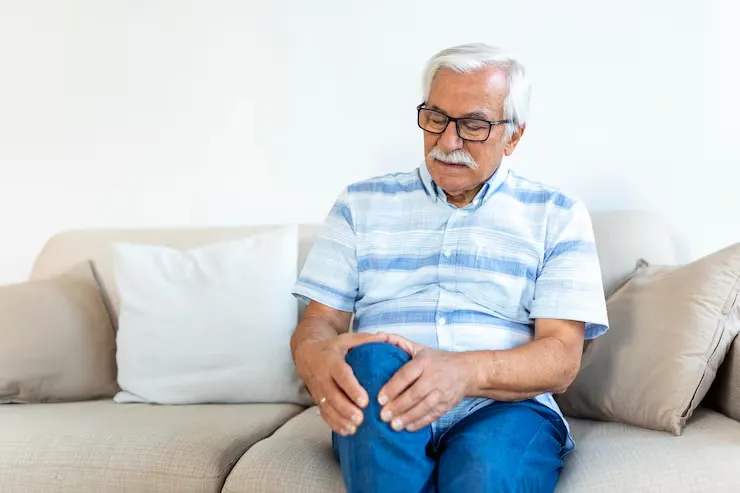

If your knees ache going up stairs, or your fingers feel stiff every morning, you've probably already searched for arthritis meaning to understand what's actually going on. It's one of the most common reasons people search for joint pain information, and also one of the most misunderstood, many people use “arthritis” as a catch-all word for any joint pain, when it actually refers to a specific group of conditions.
This guide covers what arthritis really means, its meaning in Hindi and Marathi, what causes it, and where it most commonly shows up, including the fingers and knees.
What Is Arthritis?
Arthritis is a general term for inflammation or degeneration of one or more joints, the points where two bones meet. It isn't a single disease; there are more than 100 different types, but nearly all of them cause some combination of pain, stiffness, and swelling in the affected joint.
It's also worth clearing up a common mix-up: not all joint pain is arthritis, but arthritis is the most common cause of ongoing joint pain, which is why the two terms often get used interchangeably. If you are experiencing persistent joint discomfort, you can learn more about joint pain treatment and available treatment approaches.
Arthritis Meaning in Hindi and Marathi
If you've searched ‘arthritis meaning in hindi,’ ‘arthritis kya hota h,’ or ‘arthritis in hindi,’ here's the direct answer: in Hindi, arthritis is called गठिया (Gathiya), a term almost every Hindi speaker recognizes, alongside the transliteration आर्थ्राइटिस. It's generally explained as जोड़ों की सूजन और दर्द (swelling and pain in the joints).
In Marathi, the equivalent term is संधिवात (Sandhivat), also written सांधेदुखी (Sandhedukhi, literally “joint pain”) in everyday conversation. Whether you've come across गठिया or संधिवात, both describe the same underlying issue: ongoing inflammation or wear affecting one or more joints.
Book a consultation for joint pain
What Causes Arthritis?
The cause depends heavily on the type of arthritis. The most common contributors include:
- Osteoarthritis, age-related wear and tear on the cartilage that cushions joints, most common in the knees, hips, shoulders, and fingers
- Rheumatoid arthritis, an autoimmune condition where the immune system mistakenly attacks the joints
- Injury, past bone or muscle injuries that affect a joint's long-term health
- Nutritional deficiencies, low Vitamin D, Omega-3, calcium, or magnesium can weaken bones and joint-supporting tissue
- Obesity, extra weight increases pressure on weight-bearing joints like the knees and hips
- Poor posture, prolonged poor positioning can trigger or worsen joint pain over time
Arthritis in the Fingers and Hands
The fingers and hands are among the most common places for osteoarthritis to develop, alongside the knees and hips. It typically shows up as stiffness (especially first thing in the morning), swelling around the finger joints, a dull ache that worsens with repetitive use, and sometimes a mild change in the shape of the joint over time.
Because early hand and finger changes can look similar across different types of arthritis, it's worth getting persistent finger stiffness or swelling properly evaluated rather than assuming it's simple overuse.
Arthritis Symptoms
- Swelling and inflammation around the joint
- Redness or a warm feeling over the affected area
- Morning stiffness that eases as the day goes on
- Cracking or grinding sounds when moving the joint
- Restricted movement or difficulty using the joint normally
- Symptoms that tend to worsen in cold weather
Managing Arthritis: Diet and Exercise
Alongside medical or homeopathic treatment, two things make a consistent difference for most people with arthritis: what you eat, and how you move.
On diet, an anti-inflammatory eating pattern, plenty of vegetables, omega-3-rich foods like fish and walnuts, and fewer heavily processed or fried foods, is generally recommended, while very high sugar and excess alcohol tend to worsen inflammation for many people.
On movement, low-impact, joint-friendly exercise (like walking, swimming, or gentle stretching) generally helps rather than harms arthritic joints, including the knees, as long as it's paced appropriately and doesn't push through sharp pain.
This deserves a much deeper, dedicated guide of its own given how many people search for this specifically. We'd recommend a follow-up post covering an arthritis diet plan and knee-specific exercises in full detail.
Homeopathic Approach to Arthritis
Homeopathic treatment for arthritis focuses on managing symptoms like pain, stiffness, and inflammation, and supporting the joint's overall health, rather than only masking discomfort. Commonly considered remedies include:
Rhus Toxicodendron
Well suited to morning stiffness that improves as the joint is used and movement continues through the day.
Bryonia
Indicated when pain is relieved by rest and worsens with movement, the opposite pattern to Rhus Tox.
Calcarea Fluorica
Considered for joint degeneration involving weak ligaments or bone spurs.
Ruta Graveolens
Used to support and strengthen cartilage, tendons, and ligaments around an affected joint.
Sulphur
Suited to inflammatory joint pain that tends to worsen with heat.
These remedies are shared for educational purposes. Homeopathy can help manage arthritis symptoms and support joint health, but it cannot reverse existing joint or cartilage damage, and the right remedy depends on an individual assessment by a qualified doctor.
When to See a Doctor for Joint Pain
- Joint pain or swelling that lasts two weeks or more
- Sudden, severe pain following an injury or accident
- Visible joint deformity or a joint that looks out of place
- Redness and warmth around a joint along with fever
- Joint pain that's steadily limiting your daily activities
Why Choose Dr. Tathed's Homeopathy for Arthritis and Joint Pain
At Dr. Tathed's Homeopathy Clinic, arthritis and joint pain are assessed individually, factoring in your specific pain pattern, medical history, and lifestyle, rather than applying the same treatment to every case. With clinics in Chinchwad (Pimpri-Chinchwad), Viman Nagar (Pune), and Thane West, in-person and online consultations are available.
Conclusion
Arthritis, or गठिया, or संधिवात, whichever term brought you here, covers a wide range of joint conditions, but the two most common by far are osteoarthritis and rheumatoid arthritis. Understanding which pattern fits your symptoms, and where it's showing up, whether that's your knees, hips, or fingers, is the first step toward managing it properly.
Diet and movement both play a real role in day-to-day symptom management, and there's a lot more to say on both fronts in future guides.
Dealing with Ongoing Joint Pain?
If joint pain or stiffness is affecting your daily life, book a consultation with Dr. Tathed's Homeopathy Clinic for an individualized assessment.
Find Your Nearest Homeopathy Clinic For Joint Pain
- Homeopathy Clinic in Chinchwad (PCMC), Pune : Opposite lokmanya hospital, near railway bridge, Renuka Sai Society, Ganesh Nagar, Chinchwad, Pimpri-Chinchwad, Maharashtra 411033
- Homeopathy Clinic in Viman Nagar, Pune : Datta Mandir Chowk, Unit 106, 1st Floor, Lunkad Skymax Mall, Konark Nagar, Clover Park, Viman Nagar, Pune, Maharashtra 411014
- Homeopathy Clinic in Thane West : Office No. 207, JVM’s Corner Stone, Hariniwas Circle, Lal Bahadur Shastri Marg, Naupada, Thane West, Thane, Maharashtra 400602
Frequently Asked Questions
What is arthritis? (Arthritis kya hota h?)
Arthritis is a general term for inflammation or degeneration of one or more joints. There are over 100 types, but most cause joint pain, stiffness, and swelling.
What is the meaning of arthritis in Hindi and Marathi?
In Hindi, arthritis is called गठिया (Gathiya). In Marathi, it's called संधिवात (Sandhivat) or सांधेदुखी (Sandhedukhi).
What causes arthritis?
The most common causes are age-related wear and tear (osteoarthritis) and autoimmune activity (rheumatoid arthritis), along with injury, nutritional deficiencies, obesity, and poor posture.
Why does arthritis commonly affect the fingers?
The fingers and hands are one of the most common sites for osteoarthritis, alongside the knees and hips, since these small joints undergo a lot of repetitive use over a lifetime.
What should I eat or avoid with arthritis?
An anti-inflammatory diet with plenty of vegetables and omega-3-rich foods is generally helpful, while highly processed foods, excess sugar, and alcohol tend to worsen inflammation. A dedicated diet guide is a good next read if this is your main concern.
Is exercise good or bad for arthritis, especially knee pain?
Low-impact, joint-friendly exercise like walking or swimming generally helps arthritic joints, including the knees, as long as it's paced appropriately and doesn't push through sharp pain.
Can homeopathy treat arthritis?
Homeopathy can help manage arthritis symptoms like pain, stiffness, and inflammation, and support joint health, but it cannot reverse existing joint damage. It works well alongside a proper diagnosis and lifestyle changes.
Where can I consult for arthritis and joint pain in Pune, Chinchwad or Thane?
Dr. Tathed's Homeopathy Clinic, with locations in Chinchwad (Pimpri-Chinchwad), Viman Nagar (Pune), and Thane West, offers individualized homeopathic assessment and treatment for arthritis and joint pain.