
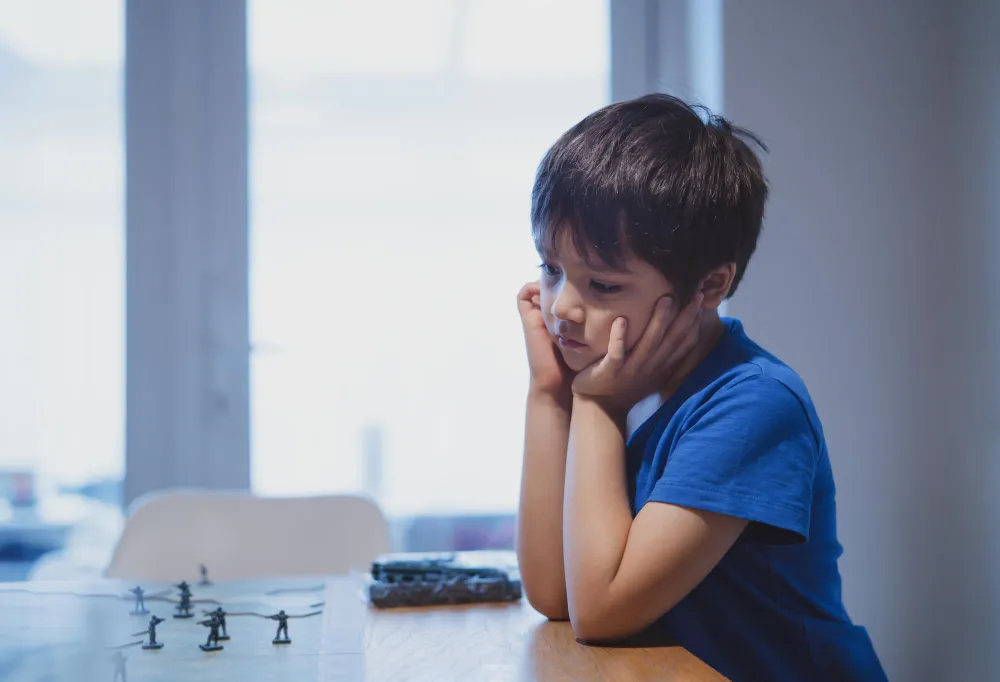
Every parent watches their child hit milestones the first smile, the first word, the first wave goodbye. When those milestones come late, or don't come at all, it's natural to worry, and it's just as natural to have someone in the family say, "wait, he'll talk when he's ready." The symptoms of autism often show up in exactly these small, easy-to-miss moments: a baby who doesn't turn toward her name, a toddler who lines up his toy cars instead of playing with them, a teenager who finds it exhausting to read the room at a family function.
Autism Spectrum Disorder (ASD) affects how a person communicates, connects with others, and takes in the world around them. In India, a large population-based study found that roughly 1 in 100 children under age 10 has autism, with nearly 1 in 8 children showing some form of neurodevelopmental condition. The World Health Organization puts the global figure at about 1 in 127 people. It isn't rare, and it isn't new it's simply under-recognised, especially outside major cities where developmental pediatricians are harder to find.
This article is for general awareness and isn't a diagnostic tool. If you notice these signs in your child or yourself, a pediatrician or developmental specialist can give you a proper evaluation.
This guide covers the symptoms of autism by age, what the term means in Marathi, how autism is screened and diagnosed in India, and the government support available to Indian families.
What Is Autism Spectrum Disorder?
Autism is a neurodevelopmental condition, not a disease or an illness. It affects how the brain processes social information, sensory input, and communication, and it's present from early childhood even when the signs aren't noticed until later.
Doctors generally assess two broad areas: differences in social communication and interaction, and restricted or repetitive patterns of behaviour, interests, or activities. Every autistic person experiences these differently, which is why it's called a spectrum. Some people need significant daily support; others live independently and simply process the world differently from most people around them. Autism isn't something to be fixed or cured it's a different way of experiencing life, though the day-to-day challenges it brings are very real for many families.
Autism Meaning in Marathi (ऑटिझम / स्वमग्नता म्हणजे काय?)
If you've searched for "autism meaning in Marathi," you've likely come across two words: ऑटिझम (a direct transliteration of "autism") and स्वमग्नता (swamagnata), the native Marathi term. स्वमग्नता roughly translates to "self-absorption" it describes how an autistic person can seem deeply engaged in their own inner world, sometimes finding it hard to read or respond to the people and sensations around them.
It helps to be clear on what स्वमग्नता is not. It isn't a mental illness, and it isn't something that develops later in life from a specific cause. It's जन्मजात congenital, present from birth and part of how a person's brain is wired, not a disease that can be treated away with medicine alone. That's exactly why early recognition matters: the sooner a family understands what's going on, the sooner they can access therapy, school support, and government schemes that genuinely help.
You'll also come across स्वमग्नता in the context of ऑटिझम दिन (World Autism Awareness Day), observed globally on 2 April to build understanding and reduce stigma.
Autism in India: How Common Is It, and Why Diagnosis Often Comes Late
Autism in India is more common than most families expect, and it's also diagnosed later than it should be. A few reasons keep coming up in Indian research and clinical practice:
- The "he'll grow out of it" wait. A child not speaking at two, or not making eye contact, gets read as shyness, a "late bloomer," or "boys talk late" a well-meaning, culturally familiar response that quietly pushes evaluation back by months or years.
- Family opinions can be mixed. In joint families especially, grandparents or relatives may disagree with a parent's instinct that something needs checking, which adds emotional friction to an already difficult decision.
- Access to specialists is uneven. Developmental pediatricians and child psychiatrists are concentrated in metro cities. A family in a smaller town near Pune or Thane may need to travel for a full evaluation, even though initial screening can often happen locally.
- Stigma around developmental and mental health conditions still discourages some families from seeking a formal diagnosis, even when they suspect something.
None of this means Indian families are doing anything wrong it reflects real gaps in awareness and access. But the data is consistent: earlier evaluation leads to earlier therapy, and earlier therapy tends to produce better outcomes. If you're the parent sitting with that quiet, nagging feeling, that instinct is worth acting on rather than waiting out.
Early Signs of Autism in Babies (0–12 Months)
Autism is rarely diagnosed in infancy, but subtle differences can sometimes be noticed from around 6 months. Signs worth watching for include:
- Limited eye contact, or eye contact that doesn't feel "connecting"
- Not smiling back at caregivers by around 6 months
- Not responding to their name by 12 months
- Little interest in games like peekaboo
- Reduced babbling, cooing, or gesturing (like waving) by 12 months
- Unusual reactions to sounds, lights, or textures either very intense or very muted
A baby missing one of these milestones doesn't automatically mean autism. Babies develop at different paces, and a single late milestone is rarely significant on its own. What matters more is a pattern several signs together, or a baby who seems to lose a skill they'd already picked up.
Signs of Autism in Toddlers (1–3 Years)
This is usually when autism becomes more noticeable, since language and social play both take off during these years. Common early signs include:
- No single words by 16 months, or no two-word phrases by 24 months
- Not pointing at objects to show interest, or not following someone else's point
- Preferring to play alone, or showing little interest in pretend play
- Repetitive movements hand-flapping, rocking, spinning, or lining up toys by size or colour
- A strong attachment to routines, with real distress when they're broken
- Sudden loss of words or social skills the child had already developed a regression that shows up in roughly a quarter of children later diagnosed with autism
- Unusual sensory responses, like covering ears at ordinary sounds, or seeking out intense sensory input such as spinning
Pediatricians in India increasingly follow the same 18-month and 24-month screening checkpoints recommended internationally, so raising a concern at these visits is exactly the right move even if it turns out to be nothing.
Symptoms of Autism in Children (4–12 Years)
By school age, autism symptoms often show up most clearly in social settings, including the classroom. Teachers or parents may notice:
- Difficulty making or keeping friends, even when the child clearly wants to
- Trouble with back-and-forth conversation, or talking at length about one topic without noticing the listener's interest
- Taking language very literally missing sarcasm, idioms, or unspoken social rules
- Intense, narrow interests, like a child who wants to talk about trains, dinosaurs, or one video game to the exclusion of almost everything else
- A strong need for routine and predictability, with meltdowns when plans change
- Sensory sensitivities to specific textures, smells, clothing tags, or noisy environments including things like crowded festivals or loud family gatherings
- Body language, tone of voice, or facial expressions that don't quite match the social situation
These traits can overlap with other conditions like ADHD or a speech and language delay, which is why a proper evaluation matters far more than working through a checklist alone.
Autism Symptoms in Teens and Adults
Autism doesn't go away with age it's lifelong but the way it shows up often changes. Many adults, especially women, learn to "mask" their traits socially, which can delay diagnosis by years, and adult diagnosis is still uncommon in India simply because awareness has grown mostly around children. Common patterns include:
- Ongoing difficulty reading social cues, body language, or unwritten social rules
- Preferring one-on-one interaction or solitary activities over group settings
- Deep, focused interests that bring genuine comfort and real expertise
- Discomfort with unstructured social situations, small talk, or last-minute changes to plans
- Sensory overwhelm in loud, bright, or crowded places
- Exhaustion after socialising, from consciously managing eye contact, tone, and conversation
- Anxiety or low mood that often builds up after years of feeling "different" without knowing why
Many adults are only diagnosed after their own child receives an autism diagnosis and they recognise the same traits in themselves often as a relief, since it finally explains a lifetime of experiences.
Screening Tools Used in India: From M-CHAT-R to Indigenous Instruments
India doesn't rely solely on Western screening tools. Alongside the globally used M-CHAT-R (for toddlers between 16 and 30 months), Indian researchers have developed and validated their own instruments, built and tested on Indian children:
- INDT-ASD (INCLEN Diagnostic Tool for Autism Spectrum Disorder) developed by the INCLEN Trust, this is one of the most widely used diagnostic tools in Indian pediatric and developmental clinics, and has been translated into several Indian languages including Hindi, Gujarati, Telugu, and Konkani. A dedicated Marathi version isn't yet among the published translations, so evaluations in Maharashtra typically proceed in English or Hindi.
- ISAA (Indian Scale for Assessment of Autism) commonly used for grading severity once autism is suspected or confirmed, and often required for disability certification.
- CASI (Chandigarh Autism Screening Instrument) and TABC (Trivandrum Autism Behaviour Checklist) regional tools developed and validated in Indian settings.
At the government level, screening often starts even earlier, through the Rashtriya Bal Swasthya Karyakram (RBSK), which trains Anganwadi and school health teams to flag developmental concerns and refer children to a District Early Intervention Centre (DEIC) for further assessment a pathway worth knowing about even if you eventually see a private specialist.
How Autism Is Diagnosed and Certified in India
A typical pathway looks like this: a pediatrician does an initial screening (often using M-CHAT-R), and if concerns come up, refers the child to a developmental pediatrician, child psychiatrist, or clinical psychologist for a full evaluation using DSM-5-TR criteria, sometimes alongside a tool like INDT-ASD or ISAA. Autism can reliably be diagnosed by age 2, though in India the average age of diagnosis tends to be later, particularly outside metro cities.
Once diagnosed, families can pursue an autism disability certificate and a UDID (Unique Disability ID) card. Autism Spectrum Disorder is one of the 21 disabilities specifically recognised under the Rights of Persons with Disabilities (RPwD) Act, 2016, and a disability assessment of 40% or more qualifies as a "benchmark disability," opening access to reservations, concessions, and welfare schemes. Certification happens through a government-authorised medical board usually at a district civil hospital or government medical college and the UDID card can be applied for online, with the certificate and supporting reports uploaded for verification.
This step is easy to postpone in the middle of an emotionally difficult diagnosis, but it's worth prioritising early: it's the single document that unlocks nearly everything else described below.
Government Support and Schemes for Families in India
India has more structured support for autism than most families realise. Once a child has a UDID card and disability certificate, several schemes become accessible:
- Niramaya health insurance (run by the National Trust, Ministry of Social Justice and Empowerment) offers health cover of up to ₹1 lakh a year for therapy, diagnostics, and medical needs related to autism, cerebral palsy, intellectual disability, and multiple disabilities, at a low or no premium depending on family income.
- DISHA early intervention centres National Trust-run centres offering therapy, counselling, and training for children with autism and their families.
- GHARAUNDA and SAMARTH schemes — long-term residential and day-care support, aimed at the "what happens after us" concern many parents carry.
- Free and inclusive education — the RPwD Act mandates free education for children with disabilities aged 6 to 18, and the Samagra Shiksha scheme funds resource teachers and inclusive-education support in mainstream schools.
- Tax and financial relief — parents or guardians of a child with a benchmark disability can claim deductions under Sections 80DD and 80U of the Income Tax Act, alongside state-specific disability pensions and railway/travel concessions.
None of these schemes replace therapy, but they meaningfully reduce the financial and logistical load on a family, and very few general "symptoms of autism" articles walk through them — which is exactly why it's worth doing here.
Living with Autism: Therapy and Complementary Homeopathic Support
Once autism is identified, the strongest evidence supports structured, individualised therapy — speech and language therapy for communication, occupational therapy for sensory and motor skills, and behavioural approaches for building daily-living and social skills. These form the backbone of care, and consistency with them tends to matter more than any single technique.
Alongside these therapies, some families explore individualised homeopathic support — not as a replacement for evidence-based intervention, but to help manage difficulties that often accompany autism, such as disturbed sleep, digestive discomfort, anxiety, or general irritability. At Dr. Tathed's Clinic, this kind of supportive care is planned around the child's overall constitution and always sits alongside — never instead of — the therapies a developmental specialist recommends.
If your family is navigating a recent diagnosis, or you're simply unsure whether what you're seeing needs an evaluation, a conversation with a pediatrician is the right place to start.
Frequently Asked Questions
What are the first signs of autism in a baby? The earliest signs often include limited eye contact, not smiling back by around 6 months, not responding to their name by 12 months, and reduced babbling or gesturing. These are subtle, and a formal diagnosis isn't usually made in infancy — but they're worth mentioning at check-ups.
At what age can autism be diagnosed? Autism can reliably be diagnosed by age 2, though in India the average age of diagnosis is often later, especially outside major cities. Earlier screening tends to lead to earlier diagnosis and earlier access to therapy.
What does autism mean in Marathi? Autism is called ऑटिझम (a direct transliteration) or स्वमग्नता (swamagnata) in Marathi, meaning roughly "self-absorption." It refers to a lifelong, congenital neurodevelopmental condition — not a mental illness or a disease that develops later in life.
How common is autism in India? A large Indian population-based study found that roughly 1 in 100 children under age 10 has autism, with nearly 1 in 8 having some form of neurodevelopmental condition — broadly in line with the WHO's global estimate of about 1 in 127 people.
Is autism recognised as a disability in India? Yes. Autism Spectrum Disorder is one of the 21 conditions specifically listed under the Rights of Persons with Disabilities (RPwD) Act, 2016. A disability assessment of 40% or more qualifies as a benchmark disability, making a child (or adult) eligible for a UDID card and related government schemes.
How do I apply for a UDID card or disability certificate for autism? After a formal diagnosis, you can apply through a government-authorised medical board — typically at a district civil hospital or government medical college — which issues the disability certificate. The certificate and reports can then be uploaded on the UDID portal to receive the physical/digital UDID card, which is valid across India.
Does the government provide financial help for autism care in India? Yes. The Niramaya health insurance scheme (National Trust) covers up to ₹1 lakh a year for therapy and medical needs, and parents/guardians can claim income tax deductions under Sections 80DD and 80U. State governments also offer disability pensions and travel concessions to UDID cardholders.
Is autism a disease that can be cured? No. Autism is a neurodevelopmental condition, not a disease, so there's no "cure" in the way there might be for an infection. Therapy and support aren't aimed at eliminating autism, but at helping the person build communication, social, and daily-living skills, and at managing any associated challenges.
Can homeopathy help with autism? Homeopathy isn't a cure for autism and shouldn't replace speech therapy, occupational therapy, or behavioural intervention. Some families use individualised homeopathic support alongside these therapies to help with related issues like sleep, digestion, or general wellbeing — always in consultation with the child's treating team.
What's the difference between a speech delay and autism? A child with a pure speech delay usually still points, makes eye contact, engages in pretend play, and uses gestures to communicate — they're just behind on words. A child on the autism spectrum often shows differences in these non-verbal, social pieces too, not just in spoken language. A specialist evaluation is the only reliable way to tell the two apart.
Schema tip: mark this FAQ block up with FAQPage schema. For a "symptoms of X" query, FAQ rich results are one of the more reliable ways to win extra SERP real estate without a ranking change.
Conclusion
The symptoms of autism look different in every person, which is exactly why "spectrum" is the right word for it. A baby who doesn't babble, a toddler who lines up toys instead of playing pretend, an adult who's spent years quietly exhausted by small talk — these are all points on the same spectrum, not separate conditions. In India, recognising these signs early matters twice over: it opens the door to therapy sooner, and it opens the door to the disability certification and government schemes that make ongoing care more affordable. Whether you're at the start of that journey or years into it, you don't have to figure it out from a single article or a single opinion in the family.
Get Guidance for Your Child or Family
If you've noticed some of these signs in your child, or in yourself, you don't have to work through it alone. Dr. Girish Tathed's team offers developmental guidance and supportive homeopathic care for autism, alongside your child's existing therapies, at our clinics in Chinchwad (Pimpri-Chinchwad), Viman Nagar (Pune), and Thane West.
📞 Call or WhatsApp: 9405435981 | 8180008068 | 7498996920
Book a consultation to discuss your child's development and explore a supportive care plan built around their needs.